

When I’ve said that I prefer to write my software in C, a common response is raised eyebrows. Dominant memes in software culture make my position unpopular. “Why would you write new code in an unsafe systems language?”, “performance isn’t everything!”, and perhaps the most common, “why subject yourself to the requirement of manually managing memory?”.
There exists a prevalent perception that manual memory management is difficult to do, difficult to do correctly, and inherently bug-prone and unstable. This way of thinking was repeatedly peddled throughout my university computer science experience. Managing memory manually in C was a temporary endeavor, only to peek under the hood—strictly for academic purposes. The idea that anyone would ever actually do manual memory management in C these days was just unthinkable—I mean, after all, it’s current year!
As I experienced it, education around memory management was for historical understanding. How did the Linux kernel originally do memory management? Let’s do an assignment, so you can see how gross it is! Oh no, a “raw” malloc! But don’t worry. Next class, you can return to the padded room, where memory-related bugs and instabilities are “impossible” (or so they claim).
After exposure to the dark underworld of manual memory management, your professor rescues you, and introduces automatic reference counting, RAII, and/or garbage collectors as the “solutions”.
I find this nonsensical. It’s not that “normal” methods of memory management in C are fine—there is an enormous amount of poorly written C code.
My stance, on the other hand, is that programmers are taught to overcomplicate the problem. After programming for several years, I’ve seen that almost all memory management problems are simpler than they first appear. By taking advantage of a problem’s concrete constraints, memory management can be easy, performant, and flexible.
In this post, I’ll present an alternative to traditional strategies of manual memory management that I’ve had success with. Let’s begin by analyzing “manual memory management in C” as it’s normally presented—the classic malloc and free interface—and its consequences.
malloc and free
malloc—which is short for “memory allocate”—is an API to which you pass some number of bytes that you need for a dynamic allocation, and returns to you a pointer to a block of memory that supports that many validly-accessible bytes.
The symmetric counterpart to malloc, free, just expects a pointer that you got from malloc, and it guarantees that whatever block of memory that pointer points to will be made available for subsequent calls to malloc.
The malloc and free interface was built to support usage code that wants to dynamically allocate blocks of memory of arbitrarily-different sizes, with each allocation having an arbitrarily-different lifetime. There is no restriction on either of those two factors, meaning the following usages are all valid:
void *p1 = malloc(512);
void *p2 = malloc(64);
void *p3 = malloc(1024*1024);
void *p4 = malloc(7);
free(p1);
free(p2);
free(p3);
free(p4);
void *p1 = malloc(512);
void *p2 = malloc(64);
void *p3 = malloc(1024*1024);
void *p4 = malloc(7);
free(p4);
free(p3);
free(p2);
free(p1);void *p1 = malloc(512);
void *p2 = malloc(64);
void *p3 = malloc(1024*1024);
void *p4 = malloc(7);
// (no freeing whatsoever)void *p1 = malloc(512);
free(p1);
void *p2 = malloc(64); // part of p1 used here?
void *p3 = malloc(1024*1024);
free(p2);
free(p3);
void *p4 = malloc(7); // part of p1/p2 used here?
free(p4);The most common (and understandable) criticism of malloc and free, or what they call “manual memory management in C”, is that using it for granular allocations with varying lifetimes across several layers in a codebase can easily lead to a rat’s nest of complexity. In these rat’s nests, it’s easy to accidentally free the same pointer twice, to access memory in a block that has already been free’d, to forget to free a pointer altogether (causing a leak), or to force your program to suffer computationally because of a need to free each small allocation in, for instance, a complex data structure with many nontrivial links between nodes.
The worst of these mistakes can lead to serious security and reliability issues. Imagine that memory is allocated with malloc, then freed once, then mistakenly freed again. An allocation may occur between the first and second call to free, which possibly reuses the already-released (at that point in time) memory. Because the usage rules of malloc and free have been broken, the allocator’s implementation and user disagree on an important detail—whether or not the allocation reusing portions of the first is allocated or not.
As I’ll present in this post, these rat’s nests can be avoided. But why, then, are they seemingly so common in C codebases, and why is there a dominant perception that they are unavoidable without more complex compiler and language features?
The Link Between Interface, Implementation, and Usage
malloc and free enforce very little on their usage code, so there is a large space of possibilities in how malloc and free are used (as the number of constraints increases, the number of solutions decreases). Many of those possibilities are the ever-common rat’s nests. The natural path for many C codebases is simply that of least (initial) resistance, which is to assume malloc and free as a suitable memory allocation interface (which is not necessarily unreasonable, given a lack of data), and so they will adopt it as a pattern. In the case of malloc and free, that means adopting a large space of possibilities—including the subset of those possibilities which include misuse, or explosions of complexity (“rat’s nests”).
There is a philosophy of abstraction in the programming world that believes in providing a certain desirable (for one reason or another) interface irrespective of the implications that interface has on its implementation. It is this philosophy that also claims that an interface can remain stable even with the implementation of the interface wildly changing. For some reason, it took several years before I became aware that the reality is precisely the opposite—an interface and its implementation are intrinsically related in subtle ways.
There is, of course, some degree to which an interface may remain stable with modifications to its implementation, but when the nature of the implementation must change, the interface must also fundamentally change, at least to avoid introducing unnecessary distortions to a problem (for instance, an interface being simply malformed for a given implementation, result in performance issues, bugs, underpowered APIs, and so on). The interface certainly hides some details, but it also explicitly does not hide others—in fact, an interface itself is defined by exposed guarantees or constraints, which both the user of the interface and the implementation must agree upon. There is certainly a more precise way to formally demonstrate this, but for now, I’ll leave it at that.
malloc and free serve as a useful example of how an interface’s definition is closely related with both its usage patterns and implementation. The fine-grained control over an individual allocation’s size and lifetime—to allow for arbitrarily overlapping lifetimes with arbitrarily different sizes—result in very few constraints on the usage code. This causes, firstly, complications in the implementation of the allocator. While that causes performance problems (and thus has caused a popular meme that “dynamic allocation in a hot loop is bad”), the worst of the issues arise in the patterns relating to usage of a malloc and free style interface.
Iterating all of these patterns would be impossible, but I’ve gathered a few for this post to help illustrate the issue.
Pattern I: The False Binary of Stack vs. Heap
You’ll notice that—in all conversations about manual memory management in C—the common case of memory allocation is never discussed, because it mostly stays in the background, is trivial to use, and more-or-less works correctly and invisibly: the stack.
Sometimes, however, the stack is not an option—I’ll get more into that later. But when malloc and free (or equivalent) have been adopted as the default memory allocation pattern in a codebase, they are the first choice whenever the stack stops being an option. This is a common pattern in several C codebases in the wild, which—knowingly or not—have been corrupted by object-oriented thinking, even if their writers do not explicitly think that is the style of thinking they are using. When an individual allocation doesn’t work on the stack, for whatever reason, the author of the codebase in question is often taught that the only other option is to use “heap allocation”, which to most people means “use malloc”. So, instead of using the stack allocator, they will switch to the extremely generic heap allocator, often being unaware that these are not the only two choices.
As such, these codebases will have de facto objects, and these objects will generally have some initialization mechanism, and some deinitialization mechanism. If the codebase adopts a rule that suggests these objects may be allocated and deallocated in the same way an individual malloc allocation may be allocated and deallocated (which is the natural path of least resistance, which requires the fewest new possibly-bad assumptions), then the object’s interface will wrap the malloc and free interface, and follow the same rules pertaining to lifetimes:
struct MyObject
{
  int x; // imagine some heavy weight stuff here!
};

MyObject *MyObjectAlloc(void)
{
  MyObject *obj = malloc(sizeof(MyObject));
  // other important initialization/mallocs happen here!
  return obj;
}

void MyObjectRelease(MyObject *object)
{
  // other important deinit/frees happen here!
  free(object);
}
When the above style of interface becomes a rule within a codebase, it is frequently built by default without accounting for a number of actual constraints which may have otherwise simplified the problem:
When does usage code actually need a
MyObject?How many of them does it need?
Is a
MyObjectonly required given the presence of another object?How easily can you predict how many are needed?
If multiple, are they freed all at once, or one at a time? In what order?
How important is it that a
MyObjectis released at all?Is it important to be able to keep track of all
MyObjectallocations independently from other allocations?
When such questions are ignored, the above pattern of wrapping a totally-generic allocation/deallocation interface becomes common parlance in a codebase, which leads to a proliferation of code that must assume full responsibility for finely-managing the lifetime of any individual object that doesn’t fit stack allocation (either because it has dynamic runtime requirements, alloca is not an option, it’s too large, or it doesn’t have lifetime requirements that fit the stack). This leads to this pattern being used even for very granular “objects”, which explodes the number of actual dynamic allocations and deallocations, and makes it far more likely that a programming mistake occurs. Pairing a single malloc with a single free is easy—pairing 1,000 mallocs with 1,000 frees—especially when many of those individual mallocs have dependencies on others—is dramatically more difficult to write once, and especially more difficult to maintain overtime.
Pattern II: Lifetime Soup
If the problem of managing 1,000 (or 10,000, or 100,000) various lifetimes wasn’t enough of a problem for you, now consider that these lifetimes often have complex dependencies on one another. Eventually, there is a graph of lifetimes, each node (lifetime) in which relies on certain assumptions about some number of other lifetimes. “Object A”, within its own lifetime, will refer to “Object B”—care, then, must be taken to ensure that, for instance, “Object B” is not freed before it is accessed through “Object A”.
If there is no organizing principle around managing these relationships and their corresponding lifetimes, through a number of subtle mistakes (that often do not arise immediately) a codebase quickly turns into a sludge, where important work is constantly deferred behind bugfixing or maintenance work—or, worse, where important work occurs before bugfixing and maintenance work, and thus bugs and maintenance issues accumulate over time.
Pattern III: Religiously Freeing Memory (free Isn’t Free)
What a memory leak literally is on a modern computer is very often glossed over in programming education. It is very frequently perceived as a scary no-no—if your program has a leak, it’s a bad program, and you’re a bad programmer, and you will go to programmer hell!
With this perception, programmers will often carefully free allocations in their program to the point of religiosity, even when doing so is strictly worse than never writing a single line of cleanup code.
To clear this up, I’ll first explain—literally—what happens when you allocate something with malloc on a computer these days, and then subsequently what happens when you fail to call free with a pointer returned to you from malloc.
When you first call malloc, you’re ultimately just calling a function that was implemented by whoever wrote the implementation of the C runtime library that you’re using. The person who wrote that code had a task—implement a dynamic memory allocator, given the constraints in the C specification. So, their job is to return you a pointer to a block of memory that’s at least as large as what you asked for, and then to also be able to release that memory (make it available for re-allocation in a later malloc) in the free implementation.
On a modern machine like the computer or phone you’re reading this on, at some point the allocator will ask the operating system for memory dynamically. Part of the utility of the C runtime library is, at the end of the day, simply abstracting over operating-system-specific code. To do this, it will request that the operating system maps new pages into the relevant virtual address space (by calling an operating system API, like VirtualAlloc on Windows). The pointer that malloc returns to you is not literally an address of any physical memory—it’s instead an address in your own virtual address space. The operating system, then, manages a mapping data structure, called a “page table”, which maps virtual addresses into physical addresses.
Being called by VirtualAlloc (or similar), the operating system will make adjustments to that mapping data structure, which changes the mapping between sections of a virtual address space and physical pages in memory. After that is complete, the operating system—whenever it chooses to schedule your program’s thread—can then prepare the memory management unit (MMU) accordingly, so that whenever your thread asks about an address, it can map to the appropriate physical address.
The main point being, whenever a process crashes (hits a hardware-level exception, like a page fault which it cannot resolve) or normally exits, the operating system continues running (or, at least, it had better), and has a whole understanding of what pages in your program’s virtual address space were mapped to physical memory addresses. So the operating system is able—and really, required, in the presence of code that cannot be trusted to never crash—to “release” the physical pages that your process originally asked for.
So, tying that all together, what happens when you never call free with a pointer that was returned to you by malloc? The first obvious point is that—of course—the malloc/free allocator fails to ever see the pointer again, and so it assumes it is still “allocated” by the usage code, which means that memory can never be reused again for another malloc allocation. That is what is called a “memory leak”. On the program exiting or crashing, no resources are truly “leaked”.
Now, to clarify, a leak may actually be a problem. For instance, if you’re building a program that runs “forever” to interact with the user through a graphical user interface, and on every frame, you call malloc several times and never free the memory you allocate, your program will leak some number of bytes per frame. Considering that—at least in dynamic scenarios—your program will be chugging through a frame around 60, 120, 144 times per second, that leak will likely add up fairly quickly. It’s possible that such a leak would prohibit normal usage of the program—for instance, after 30 minutes, an allocation failure occurs, or the operating system spends far too much time paging in memory from disk to allow your program’s memory usage to continuously grow.
On the other hand, however, a leak is very often not a problem—for example, when allocating memory that needs to be allocated for the duration of the program, or if you expect the program to only boot up and perform a task, then to close.
In other words, you may treat the operating system as “the ultimate garbage collector”—freeing memory when it is unnecessary will simply waste both your and the user’s time, and lead to code complexity and bugs that would otherwise not exist. Unfortunately, many popular programming education resources teach that cleanup code is always necessary. This is false.
Pattern IV: Lifetime Beginning/Ending Asymmetry
The malloc and free interface is symmetric—for each call to malloc that returns a pointer to memory that must be freed, there will be one call to free. So for instance, if memory for an entity in a game world is malloc’d when the entity is spawned, then it will be free’d when the entity is killed or deleted.
A problem arises when the manner in which memory is acquired does not match the manner in which it is ultimately released. For example, if I load a level in my game engine’s level editor, and for each entity that is spawned some number of mallocs occur, and for each entity I spawn while editing the level some more mallocs occur, then I want to unload that level and load a different one, then there is no “free all of the memory I allocated for this level” button. Each malloc must receive its symmetric free, and so I must iterate all of the entities and free each result that was returned to me from malloc.
There is no “malloc checker” in C compilers, and there is no obvious element of incorrectness that comes from forgetting to free something in such a codepath (unlike the element of incorrectness you’d quickly find on forgetting to allocate something), and so it’s quite easy to allow the “free everything” path to become out-of-sync with the “allocate one thing” path. This leads to both bugs and leaks—and, of course, it contributes to the sum-total of code required to implement something.
Abstraction Through Obfuscation
The above patterns are surely not exhaustive, but they hopefully provide a decent picture of how the nature of an interface like malloc and free can spiral into an out-of-control mess, where bugs and leaks regularly arise. This mess will ultimately result in a decline in software quality, an increase in iteration time, and thus a decline in one’s ability to meaningfully work on a project (other than purely maintaining its inertia—for instance, by fixing a leak reported by a customer).
Generating Inconvenient Code: RAII
One attempted solution to this problem found in the modern programming world is to introduce compiler and language features to automatically generate “inconvenient code”—in this case, that being the code responsible for correctly calling initialization and deinitialization code (which may include allocations and deallocations).
This is done in the C++ world through RAII—whenever an object goes out of scope, either by being initially allocated on the stack, explicitly allocated (in C++, through new and delete), or by being within another object that is going out of scope, some code will automatically be called, which is responsible for cleanup (the destructor). When an object’s lifetime starts, then some other code will automatically be called, which is responsible for initialization (the constructor).
The constructor and destructor of an object mark the beginning and ending (respectively) of that object’s lifetime. The fact that this has the same overhead that malloc and free had is not relevant—it is purely trying to automate the generation of some code by assuming initialization and deinitialization are coupled with an object’s lifetime. This, of course, does not eliminate all possible bugs (misuse is still possible, and often not checkable in a language like C++)—so, this idea is often paired in newer languages with heavier (and more complex) compile-time checking features, which attempt to both automate this code generation, and prohibit misuse.
The Enforcement Bureaucracy: Garbage Collection
Another attempted solution is garbage collection, which is a large enforcement structure that tracks everything and interrupts productive work in order to perform its function (much like a government agency, except in this case, the garbage collector is ostensibly doing something approximating useful work—although both function by stealing valuable resources involuntarily). A garbage collector will periodically interrupt a running program—which is running normally—to explore the set of individual malloc-style allocations (objects) and find which of them are still being referenced somewhere in live data structures, thus detecting the termination of some allocation lifetimes, and being able to release those allocations. In many cases, garbage collectors do actually perform their function, although nevertheless it’s still possible to produce de facto leaks, by mistakenly holding an unnecessary reference to an object, which prohibits the garbage collector from releasing it.
An Alternative Approach: Change The Problem’s Nature
The above solution attempts see the problem as fundamentally an automation or checking problem. It isn’t simply that memory management was being approached in an entirely wrong way—instead, the malloc and free rat’s nest is simply a part of the memory management problem’s intrinsic nature, and so tooling must simply aid the programmer in making fewer mistakes.
This view follows quite naturally from another aspect of modern programming thinking (and education), which claims many problems are gross and complex, and thus we need abstraction to make them appear simpler. It’s not, advocates of this philosophy claim, that the problems themselves should be simplified—they are, on the other hand, intrinsically complex, and it is the job of tooling to make them appear less complex.
I don’t agree with this view for a number of reasons. Firstly, complexity hidden by an interface (be it an API or a tool’s controls) does not simply disappear—it can be detected through performance problems, subtle bugs, and a lack of composability. Secondly, there is not a single user and a single producer in computing—the ecosystem is a complex graph of interdependent problems. There are “leaf nodes” in this graph, where produced software has no dependents—this would be, for instance, a game that never has any of its code reused. But the vast majority of the graph is producing software that must be composed with other software in unpredictable ways, and that production occurs by composing other dependency software in unpredictable ways. So complexity introduced at any point in this graph does not simply disappear—instead, it compounds. It is no coincidence that modern software—after many decades of cruft accumulation and software composition—seems to be slower, buggier, less reliable, and more frustrating to use than it should be.
Nevertheless, this view is dominant in the programming sphere at large, and as such is responsible for a host of solutions that don’t mind adding complexity to the problem.
My approach, on the other hand, is this: instead of assuming that malloc and free were the correct low-level operations, we can change the memory allocation interface—tweaking what the user and implementation agree on—to simplify the problem and eliminate many of the problems found in the traditional malloc and free style of memory management.
What, exactly, does that approach look like? To begin understanding it, let’s take a look at another style of memory management in C that does not have the same problems that malloc and free do: the stack.
Memory “Management” With The Stack
As I mentioned earlier, the primary focus of criticism on memory management in C is on the malloc and free interface, and not the stack. That is for a good reason—using the stack correctly is remarkably simple. Misusing it is, of course, still possible. But after a new C programmer learns a few simple rules, it’s not particularly difficult to avoid almost all mistakes.
With stack allocation, the idea is simple: multiple allocation lifetimes—all using a single block of memory—may be in-flight at a single time, but the end of a lifetime may never cross the beginning of another lifetime. This means that several nested allocation lifetimes may exist, but it is not an entirely arbitrary timeline of overlapping allocation lifetimes (as in the case of malloc and free).
This rule can be clearly visualized by looking at virtually any CPU profiler, many of which make use of what’s called a “flame graph”:
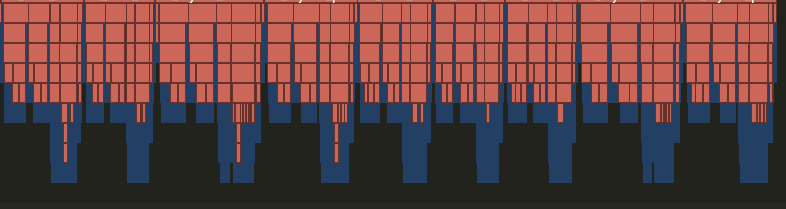
Each block in the above picture corresponds with one of these lifetimes. Once a lifetime has been entered, its parent lifetime cannot end until it first ends.
When a new lifetime opens—delimited by the { symbol in C’s syntax—that signifies a new “scope” on the stack. When a lifetime closes—delimited by the } symbol—the lifetime began by the corresponding { symbol is terminated. Any variables declared within those two symbols “belong” to that lifetime.
The syntax makes the rule of a lifetime’s end not crossing another lifetime’s beginning quite clear. The following is a valid case of multiple lifetimes:
// lifetime A
{
  int x = 0; // an integer is allocated in this scope
  int y = 0; // another integer is allocated in this scope

  // lifetime B
  {
    int z = 0; // an integer is allocated in this scope
  } // end of lifetime B

} // end of lifetime A
But the following idea is not valid (and cannot even be expressed within the grammar):
// lifetime A
{
  int x = 0; // an integer is allocated in this scope
  int y = 0; // another integer is allocated in this scope

  // lifetime B
  {
    int z = 0; // an integer is allocated in this scope

} // end of lifetime A

  } // end of lifetime B
The reasons why this cannot be expressed in C’s grammar are clear when considering the compiler tasked with parsing the above text. Because whitespace is insignificant in C, the first } encountered will be identified as closing lifetime B, and so it can not be interpreted as ending lifetime A.
The inability of the grammar to express that concept is ultimately irrelevant, though (you can imagine a language’s syntax that does make such a concept expressible)—what’s more interesting is the implications that this rule has on the “stack allocator”.
First what’s notable is that the concept of a lifetime has become detached from individual allocations, and is now delimited independently from allocations. When an allocation occurs (a variable is declared on the stack), its lifetime is chosen by virtue of which scope it is placed within. This is unlike malloc and free, which offers per-individual-allocation lifetime control. This allows an individual lifetime to be used to group many allocations into a single common case. Note that, additionally, this fits the “asymmetric allocation and deallocation” pattern I mentioned earlier—allocations can occur within a scope in sporadic ways, but all end together simultaneously (quite similar to the aforementioned “unloading a level in my game’s level editor” example).
Secondly, because of the rule that lifetimes within the stack may only exist entirely within other lifetimes, implementing a stack allocator is trivial. All you need is a single block of memory and a single integer:
U8 *stack_memory = ...;
U64 stack_alloc_pos = ...;

// allocating 64 bytes on the stack:
void *ptr = stack_memory + stack_alloc_pos; // `ptr` points to 64 bytes
stack_alloc_pos += 64;

// popping 64 bytes from the stack:
stack_alloc_pos -= 64;
To create a “sub-lifetime”, the “allocation position” (stack_alloc_pos) needs to simply be remembered before the sub-lifetime begins, and then it must be restored when the sub-lifetime ends:
U8 *stack_memory = ...;
U64 stack_alloc_pos = ...;

U64 restore_stack_alloc_pos = stack_alloc_pos;
{
  // in here, increment stack_alloc_pos as needed!
}
stack_alloc_pos = restore_stack_alloc_pos;
You can also imagine “freeing” everything in the entire stack block, just by setting stack_alloc_pos to 0.
The above is expressed in C syntax, but if you dig into what stack allocation actually means at the assembly level, you’ll find that C’s stack is implemented much like this. Notice how computationally trivial it is to perform both allocations and deallocations on the stack.
That is all well and good, and it’s great that the stack is so simple, and that it’s trivial to use it. But the stack is not an option in many cases—that is, after all, why malloc and free are often used as “the alternative”.
Why is the stack not an option in some cases, though?
When The Stack Fails
Let’s form an example where the stack would simply not work. Let’s start with the simplest example:

In the above image, I’m beginning a lifetime at the red { character, and ending that lifetime at the red } character. This clearly breaks the rules of the stack, because the lifetime I am attempting to form does not fit within the parent lifetimes I am attempting to begin or end the lifetime within.
Note that this lifetime can still be expressed in this timeline! I would simply need to begin the lifetime several ancestor scopes higher, and end the lifetime at that same level. But, doing that is often still not an option, because of composability.
In the below picture, the top red rectangle delimits one layer of code, and the bottom delimits another layer of code. Imagine that the top layer is some high-level application code, and the bottom layer is a helper library for parsing a file format.

Memory allocation is almost always coupled with the particular details of a task, and this is especially true in parsing, so in order for the application code (top) to call into the parsing code (bottom), the application code would need to do all of the memory allocation, somehow without doing any of the work involved in usefully using or filling that memory.
While that may be in principle feasible (even though in many practical scenarios, it’s not feasible), we can still form a case that is not theoretically feasible at all, by introducing another overlapping lifetime:

In this case, it’s impossible to keep the same order of events, while keeping both lifetimes in the same stack. In cases like this, the stack stops being an option.
Untangling Lifetimes, With Arenas
But now, consider this: can you tackle the same lifetime problems as above, but with the ability to construct as many independent stacks as you need? The answer being “yes, of course”—now, solving each problem is trivial. Some lifetimes must simply belong to different stacks than others.
This is the approach of the arena allocator: take the absurdly simple linear allocator, which offers lightning fast allocation and deallocation, eliminating per-allocation freeing requirements, first being proved out by the stack, and make that a formal allocator concept—the “arena”. Usage code can make as many arenas as necessary, and choose them at will for specific allocations.
An arena allocator’s fundamental API, then, may look like this:
// create or destroy a 'stack' - an "arena"
Arena *ArenaAlloc(void);
void ArenaRelease(Arena *arena);

// push some bytes onto the 'stack' - the way to allocate
void *ArenaPush(Arena *arena, U64 size);
void *ArenaPushZero(Arena *arena, U64 size);

// some macro helpers that I've found nice:
#define PushArray(arena, type, count) (type *)ArenaPush((arena), sizeof(type)*(count))
#define PushArrayZero(arena, type, count) (type *)ArenaPushZero((arena), sizeof(type)*(count))
#define PushStruct(arena, type) PushArray((arena), (type), 1)
#define PushStructZero(arena, type) PushArrayZero((arena), (type), 1)

// pop some bytes off the 'stack' - the way to free
void ArenaPop(Arena *arena, U64 size);

// get the # of bytes currently allocated.
U64 ArenaGetPos(Arena *arena);

// also some useful popping helpers:
void ArenaSetPosBack(Arena *arena, U64 pos);
void ArenaClear(Arena *arena);
Notice that, at the limit, this allocator becomes equivalent to malloc and free. To see this, consider that each malloc and free can simply be identified as beginning and ending their own little “stack”, where it’s only used for a single allocation. Using an arena in such a way—while it works—is not where this style of allocator will make an obvious difference.
The key point, I’ve found, is that in virtually every case, programs do not operate at such a limit. You don’t form a new scope for each new variable you declare on the stack—similarly, you don’t need an arena for each new allocation with a stack-breaking lifetime requirement. In almost every case, a large number of allocations can be bucketed into the same arena. And in those cases, once your arenas are set up accordingly, the requirement to deallocate any allocation disappears (other than the deallocation of the arena in its entirety, if required). Once you’ve performed an allocation, you’ve chosen an arena, and by virtue of that, the allocation’s corresponding memory will be made available again in accordance with the arena’s overarching lifetime.
By getting just a bit more organized about which arena we choose for an allocation, we’ve freed ourselves from the burden of freeing all of our dynamic allocations. We’ve also made it much easier to, for instance, track memory usage in our application, or bucket all allocations for a particular purpose, which may be useful for debugging or performance—we now have a fairly obvious path to determine which arena a given allocation is within, and to free all allocations in any arena we choose, irrespective of who pushed what onto the arena, when, and in what order.
A very high level description of an arena is “a handle to which allocations are bound”. When an allocation occurs, it is “bound” to an “arena handle”. This makes it easily expressible to, for instance, clear all allocations “bound” to an “arena handle”.
Arena Parameterization
One useful property of arenas is that they gracefully propagate through several layers in a codebase. This occurs through the parameterization of codepaths with the arena they use to perform allocations.
// the function is *asking the user* where to allocate
ComplexStructure *MakeComplexStructure(Arena *arena);
It is trivial, then, to identify which functions are performing allocations. And because, in an API like the above, the arena is a required parameter, the caller must choose an arena, and thus determine the lifetime of any persistent allocations.
For instance, imagine that there is a file format which encodes a tree structure (like JSON, or Metadesk). A parser for that file format will produce a complex tree structure, perhaps with pointers linking various tree nodes together. With arenas, that parsing API can be a function that takes (Arena*, String8) → (Node) (where a single Node contains pointers to, for instance, its children nodes). The usage code passes an arena where it’d like the results allocated, instead of—for instance—having to carefully free the resultant structure at a later time. By choosing an arena, the freeing work is complete.
This simplifies all codepaths in this system. The parsing code becomes simpler, because it does not have to have any cleanup code whatsoever. The calling code becomes simpler, because it does not have to manage the lifetime of the parsed tree independently. And finally, the allocator code itself remains nearly trivial, and lightning fast.
Contrast this with a malloc-style interface propagated throughout the system. Because of the allocator’s assumption of arbitrary lifetimes and arbitrary sizes, the allocator code itself becomes more complex (it is a generic heap-style allocator); the calling code becomes more complex (it must manage the lifetime of the parsed structure); and the parser code becomes more complex (it must provide a careful freeing routine). So, this is not merely a choice—the arena solution is simpler and faster by every important metric.
Composition With More Complex Allocators
As I’ve mentioned, a key concept behind the arena is grouping lifetimes together. But that, sometimes, is not as simple as it seems.
For instance, imagine I’ve allocated storage for 1,000 entities in my game’s level editor on an arena. But now, I’d like to go and remove one out of the middle. If each entity were malloc’d, then all I would need to do is free the allocation for the entity in the middle. But if that storage is directly on an arena, how might that work?
Recall what “freeing memory” literally means—it means informing whatever allocator you allocated memory from that the memory you allocated is now available for future allocations, and you don’t plan on using anymore (at least, before allocating something new).
This desired behavior—of reusing memory that has been released—is still possible with an arena. To demonstrate the concept, I’ll provide a simple growable pool allocator implementation that composes with an arena.
A pool allocator only offers allocations of a fixed size, but with each allocation having an arbitrarily-different lifetime from all other allocations. So, it’s much simpler to implement than a fully generic malloc-style allocator, which makes it useful to demonstrate my point of “compositions with arenas”. That being said, keep in mind that malloc-style allocators can still be implemented as a composition with an arena—I’ve implemented a number of more sophisticated allocators as compositions with arenas, including malloc-style allocators, a quad-tree allocator, and others.
But in any case, here is what a simple pool allocator will look like:
struct Entity
{
  Entity *next;
  Vec2F32 position;
  Vec2F32 velocity;
  // some more stuff in here
};

struct GameState
{
  Arena *permanent_arena;
  Entity *first_free_entity;
};

Entity *EntityAlloc(GameState *game_state)
{
  // first, try to grab the top of the free list...
  Entity *result = game_state->first_free_entity;
  if(result != 0)
  {
    game_state->first_free_entity = game_state->first_free_entity->next;
    MemoryZeroStruct(result);
  }

  // if the free list was empty, push a new entity onto the arena
  else
  {
    result = PushStructZero(game_state->permanent_arena, Entity);
  }

  return result;
}

void EntityRelease(GameState *game_state, Entity *entity)
{
  // releasing -> push onto free list. next allocation
  // will take the top of the free list, not push onto
  // the arena.
  entity->next = game_state->first_free_entity;
  game_state->first_free_entity = entity;
}
A Survey Of Arena Specializations
Arenas are an extremely versatile building block. To aid in furthering understanding of just how versatile they are, I’ve gathered a number of scenarios—perhaps non-obvious to some readers—in which an arena clicks perfectly into place.
Frame Arenas
In games and graphical applications, programs are organized at a top-level by a loop. This loop performs the same operations repeatedly, in order to communicate to the user, and receive information from the user. On each iteration of this loop, a frame is produced.
It’s very common to have per-frame concepts in this scenario. For instance, you might be building a user interface every frame, or producing a batch of drawing commands. In such cases, it’s useful to have a lifetime that exists for the duration of a single frame. This can easily be implemented with an arena. The arena itself would be allocated permanently, but at the beginning of each frame, it has its allocation counter reset to 0 (e.g. via the ArenaClear API I described above). So, if in application code you’d like to dynamically allocate a few complicated strings for the purposes of rendering, you can simply use the frame arena, and know that the memory will be released at an appropriate time.
It’s also very common to refer to the previous frame’s state on any given frame. This can be done with a simple extension to the “frame arena” idea—instead of having a single frame arena, have two, and switch between them each frame (in effect, “double-buffering” the frame arena). This allows safe references to the prior frame’s state.
Per-Thread Scratch Arenas
You may now see that the stack, as it is normally understood in C, is almost like a specialized per-thread arena. It’s very common to use the stack as a sort of “scratch arena”, by “pushing” (declaring) a temporary buffer in a local scope, and using it to do some useful work. While that is ultimately true, there are a few limitations of the stack that make it underpowered.
First of all, the stack is coupled with the call stack—so it’s not possible to, for example, push something onto the stack, and return back to a function’s caller, while keeping that allocation there (without making some brittle assumptions that inevitably break).
Secondly, the stack cannot compose with any code you’ve written that uses arenas. So if you’d like to, for instance, call a function with a signature like Node *ParseString(Arena *arena, String8 string), there isn’t really a way to tell the function to use the stack—it is written to use arena.
This is where per-thread scratch arenas become useful. These are simply thread-local arenas, which can be retrieved at any time. They can then be used with the “temporary sub-lifetime” trick I introduced earlier, with an additional API layered over the core arena API:
struct ArenaTemp
{
  Arena *arena;
  U64 pos;
};

ArenaTemp ArenaTempBegin(Arena *arena); // grabs arena's position
void ArenaTempEnd(ArenaTemp temp);      // restores arena's position
The API to retrieve a scratch arena, then, can almost be the following:
ArenaTemp GetScratch(void); // grabs a thread-local scratch arena
#define ReleaseScratch(t) ArenaTempEnd(t)
Although the above is not quite sufficient. The reason why is quite subtle, but let me explain with an example:
void *FunctionA(Arena *arena)
{
  ArenaTemp scratch = GetScratch();
  void *result = PushArrayZero(arena, U8, 1024);
  // fill result...
  ReleaseScratch(scratch);
  return result;
}

void FunctionB(void)
{
  ArenaTemp scratch = GetScratch();
  void *result = FunctionA(scratch.arena);
  // use result
  ReleaseScratch(scratch);
}
Notice that, in the above case, if there is only a single per-thread scratch arena, both FunctionA and FunctionB grab the same scratch arena. The difference is that, in FunctionA, it is treating scratch.arena differently than arena. scratch.arena is an arena it’s using for temporary work that it expects to disappear before returning—arena is where it is allocating persistent results for the caller.
But, because scratch.arena is arena, the result memory is actually freed before returning to the caller.
So, another rule must be adopted. When GetScratch is called, it must take any arenas being used for persistent allocations, to ensure that it returns a different arena, to avoid mixing persistent allocations with scratch allocations. The API, then, becomes the following:
ArenaTemp GetScratch(Arena **conflicts, U64 conflict_count); // grabs a thread-local scratch arena
#define ReleaseScratch(t) ArenaTempEnd(t)
If only a single “persistent” arena is present at any point in any codepath (e.g. a caller never passes in two arenas), then you will not need more than two scratch arenas. Those two scratch arenas can be used for arbitrarily-deep call stacks, because each frame in any call stack will alternate between using a single arena for persistent allocations, and the other for scratch allocations.
This issue is, as I said, very subtle, and it does require an extra rule that makes scratch arenas slightly more complex to use correctly. But, the day-to-day habit of using scratch arenas is still not particularly difficult to follow: “If you want a scratch arena, and an arena is already in scope for persistent allocations, then pass it into GetScratch. If you introduce an arena parameterization into an already-written codepath, then find all instances of GetScratch and update them accordingly”.
Dynamic Array Arenas
As I’ll explain in the Implementation Notes, an arena implementation can have a strategy for growing and shrinking (while not relocating existing allocations). This makes them useful for storing collections of information where the size is not known upfront.
Depending on the exact growth strategy, this either makes arenas a suitable replacement for dynamic arrays, or a perfect implementation of one. Because the specifics of this style of arena usage are tightly coupled with implementation details, I’ll just mention this for now, and hopefully the Implementation Notes will illuminate the parts I’m glossing over at the moment.
Implementation Notes
I’ve already introduced the basic mechanism for implementing an arena, when I described how the stack works. An arena works in precisely the same way (although you can play with the details—for example, auto-aligning allocations).
There is one aspect I’ve not yet covered, however, which is what happens when the arena runs out of storage. There are a number of strategies one might employ in tackling this scenario, depending on their particular case.
One strategy is to simply pre-allocate a single fixed-size block of memory for an arena, and abort when storage runs out, because the project has strict memory usage requirements (if it’s, for example, on an embedded device).
The more common case, though, is that you’re writing code for, say, a modern consumer desktop computer, or a modern game console. In this case, it’s much easier to have a strategy for growing the arena’s storage when it runs out.
One strategy is to spread the arena across a variably-sized linked list of large blocks. If there is not enough room for a new allocation on an arena, your implementation falls back to asking the operating system for a new block, and then begins allocating on the new block. When the arena’s allocation position is pushed far back enough, it can return to the previous block. This notably, eliminates the guarantee of memory contiguity within the arena, which makes the arena unusable for implementing a dynamic array, because a dynamic array can be trivially accessed with a single offset into a single block. In this case, to access an arbitrary offset in the storage, you first would need to scan the chain of blocks. This is likely not prohibitively expensive, and the exact performance characteristics can be tweaked by changing the block size—but it does mean using it is more nuanced than just a single block of memory.
Another fancier strategy is to take advantage of modern MMUs and 64-bit CPUs (which are virtually ubiquitous these days). On modern PCs, for instance, it’s likely that you have 48 bits (256 terabytes!) of virtual address space at your disposal. This means, functionally, that you can still have arenas both grow dynamically, and work with just a single block (and thus maintain the guarantee of memory contiguity). Instead of committing physical storage for the entire block upfront (e.g. by using malloc for the storage), the implementation simply reserves the address range in your virtual address space (e.g. by using VirtualAlloc on Windows). Then, when the arena reaches a new page in the virtual address space range that has not been backed by physical memory, it will request more physical memory from the operating system. In this case, you still must decide on an upper-bound for your arena storage, but because of the power of exponentiation, this upper-bound can be ridiculously large (say, 64 gigabytes). So, in short, reserve a massive upper-bound of contiguous virtual address space, then commit physical pages as needed.
Finally, it’s easy to compose all of the above strategies, or make them all available in various scenarios, through the same API. So, don’t assume they’re mutually exclusive!
Before choosing any strategy, carefully consider which platforms you’re writing for, and the real constraints on your solution. For example, my understanding is that the Nintendo Switch has 38 bits of virtual address space. The magic growing arena can still work here, but you’ll have a tighter constraint on address space.
Closing Thoughts
Learning to use arenas to organize lifetimes revolutionized my experience writing C. I almost never think about memory management anymore. It is not particularly more cumbersome than writing in a garbage-collected scripting language, but it required none of the performance or toolchain complexity costs, and it didn’t require me to sacrifice contact with the details.
Simple memory management doesn’t take a gigantic, complex compiler. It doesn’t take a garbage collector. And it doesn’t require sacrifice of contact with lower level details. Instead, it arises through a harmony between lower and higher levels. For this reason, I reject the modern programmer’s conception of “high-level vs. low-level”, and how “lower level details” are considered “gross”, inconvenient, and annoying. Lower level details are nothing to shy away from. They’re a necessary part of the problem’s reality, and by giving them their dues, code can benefit at both high and low levels.
If you enjoyed this post, please consider subscribing. Thanks for reading.
-Ryan
A couple of questions:
1. People usually make a scratch arena locals to a thread using something like __declspec(thread). What if you're on a platform or project that can't use thread-local storage? I usually see people handle this by passing around a "thread context" Care to comment on that?
2. The push and pop operator on the current arena implementation aren't atomic, which mean they aren't thread-safe. How do you go about dealing with memory management for multithreading?
3. Do you think the idea of ArenaTemp can be made more abstract and applied to other kinds of allocators? For example, I may have a generic heap allocator that keeps a free list and allows for out-of-order alloc and free allocations. I can still create an ArenaTemp for this allocator by storing the free list in the ArenaTempBegin and restoring it in the ArenaTempEnd function. The same also goes for a pool allocator, for example. I can still store the current free list and reset it later.
This concept is new to me, so I'm not sure I quite understand it's usage very well.
How is the usage of a pool allocator any different from a general purpose heap allocator? The lifetimes of the (in this case) entities can be arbitrarily different, so the "stack" way of thinking doesn't seem to hold. The example also doesn't seem to care about a specific scope for each group of objects, as it's done over the global game state (or do you expect to reset the game state several times, therefore gaining the benefit of just popping everything from the "permanent" arena?)
Thanks for the article